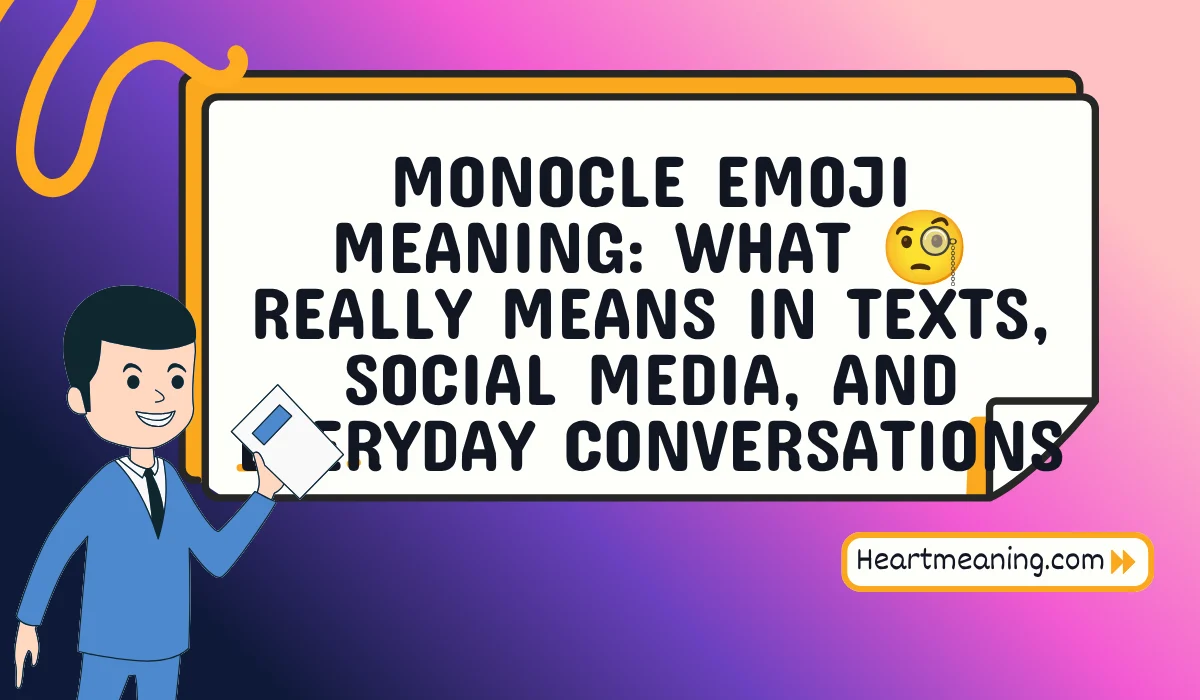
The monocle emoji 🧐 is one of those emojis that many people recognize but don’t always fully understand. You may have seen it in a text message, social media comment, meme, or online discussion and wondered what the sender was trying to say.
Does it mean intelligence? Suspicion? Curiosity? Judgment?
The answer depends on the situation.
People search for the monocle emoji meaning because the emoji carries multiple layers of interpretation. Unlike a simple smiley face, the monocle emoji often communicates subtle emotions and thoughts that aren’t immediately obvious.
In this guide, you’ll learn exactly what 🧐 means, where it came from, how people use it online, and how to respond when someone sends it to you.
Monocle Emoji Meaning – Quick Meaning
The monocle emoji (🧐) usually represents:
- Careful observation
- Suspicion
- Curiosity
- Deep thinking
- Skepticism
- Examining something closely
In simple terms, it’s often used when someone wants to say:
“Hmm, let me think about that.”
“That doesn’t seem quite right.”
“I’m looking at this more closely.”
Quick Definition
🧐 = Looking carefully, questioning something, or analyzing details before accepting them.
Origin & Background
The monocle emoji was introduced as part of modern emoji sets to represent a face wearing a monocle—a single corrective lens historically associated with wealthy gentlemen, scholars, aristocrats, and intellectuals.
For centuries, monocles were linked to people who appeared:
- Educated
- Analytical
- Sophisticated
- Detail-oriented
As internet culture evolved, users began giving the emoji additional meanings.
Instead of representing literal eyewear, people started using it to show:
- Doubt
- Investigation
- Curiosity
- Sarcasm
- Mock seriousness
Today, the monocle emoji is commonly used across:
- TikTok
- X (Twitter)
- Discord
Its popularity grew because it perfectly captures the modern online habit of questioning information before believing it.
Real-Life Conversations
WhatsApp Conversation
Person A:
I finished the entire project in two hours.
Person B:
🧐 Two hours? The same project everyone else needed two days for?
Person A:
Okay, maybe three hours.
Instagram DM
Person A:
I think I saw a celebrity at the grocery store today.
Person B:
🧐 Are you sure it wasn’t just someone who looked similar?
Person A:
Now that you mention it, maybe.
TikTok Comments
Creator:
I made $10,000 in one weekend.
Commenter 1:
🧐 Interesting…
Commenter 2:
We’re going to need more details.
Text Message
Person A:
I accidentally ate six slices of pizza.
Person B:
Accidentally? 🧐
Person A:
Okay, intentionally.
Emotional & Psychological Meaning
The monocle emoji is interesting because it reflects a very human behavior: evaluating information before accepting it.
People naturally use 🧐 when they experience:
Curiosity
Humans are curious by nature. The emoji often appears when someone wants more information.
Example:
“You quit your job and started a business? 🧐”
The person isn’t judging—they’re interested.
Healthy Skepticism
In today’s digital world, people encounter countless claims every day.
The monocle emoji allows users to politely express doubt without directly calling someone dishonest.
Example:
“You never study but always get perfect grades? 🧐”
Intellectual Engagement
Some people use 🧐 simply because they’re thinking deeply.
It signals:
- Analysis
- Reflection
- Consideration
Playful Judgment
Many conversations use the emoji humorously.
It often says:
“I’m not fully convinced.”
while keeping the mood light and friendly.
Usage in Different Contexts
Social Media
On social media, 🧐 often means:
- Questioning a claim
- Looking for evidence
- Investigating information
- Reacting to surprising content
Example:
“This influencer says they became rich overnight 🧐”
Friends & Relationships
Among friends, the emoji is usually playful.
Examples:
“You said you’d only buy one thing and came home with five bags 🧐”
“You weren’t hungry but ate my fries 🧐”
The tone is generally teasing rather than serious.
Work or Professional Settings
In professional conversations, the monocle emoji can indicate:
- Reviewing information
- Seeking clarification
- Evaluating details
Example:
“The numbers don’t match the report 🧐”
However, use caution because some people may interpret it as criticism.
Casual vs Serious Tone
| Context | Meaning |
|---|---|
| Casual chat | Playful skepticism |
| Social media | Questioning information |
| Workplace | Reviewing details |
| Debate | Analyzing arguments |
| Humor | Mock investigation |
Common Misunderstandings
Mistake #1: Assuming It Always Means Intelligence
Many people think the monocle emoji only represents being smart.
In reality, it often represents questioning or examining something.
Mistake #2: Thinking It’s Always Negative
The emoji isn’t automatically judgmental.
Sometimes it simply means:
“Tell me more.”
Mistake #3: Confusing It With Disapproval
A person may send 🧐 because they’re curious—not because they disagree.
Context matters.
Mistake #4: Using It During Sensitive Conversations
The emoji can sometimes appear sarcastic.
Avoid using it when discussing:
- Serious personal problems
- Grief
- Medical issues
- Emotional conflicts
Comparison Table
| Term/Emoji | Meaning | Similarity to 🧐 |
|---|---|---|
| 🤔 Thinking Face | Considering ideas | Very similar |
| 👀 Eyes | Watching closely | Similar |
| 🕵️ Detective | Investigating | Closely related |
| 🤨 Raised Eyebrow | Doubt or suspicion | Similar |
| 😐 Neutral Face | Emotionless reaction | Less analytical |
| ✅ Agreement | Acceptance | Opposite |
| 😍 Heart Eyes | Admiration | Opposite emotion |
| 🤓 Nerd Face | Intelligence | Related but different |
Key Insight
The monocle emoji stands out because it combines curiosity, skepticism, and analysis into a single reaction. It doesn’t simply observe—it evaluates.
Variations and Types of Monocle Emoji Usage
1. Curious Monocle 🧐
Used when someone genuinely wants more information.
2. Skeptical Monocle 🧐
Expresses doubt about a statement.
3. Detective Monocle 🧐
Suggests investigating a situation.
4. Sarcastic Monocle 🧐
Used humorously to question obvious excuses.
5. Intellectual Monocle 🧐
Shows thoughtful analysis.
6. Fact-Checking Monocle 🧐
Appears when verifying information.
7. Playful Monocle 🧐
Friendly teasing among friends.
8. Observational Monocle 🧐
Noticing unusual behavior.
9. Suspicious Monocle 🧐
Questioning someone’s explanation.
10. Analytical Monocle 🧐
Examining details before making a decision.
How to Respond When Someone Uses It
Casual Replies
- “Fair question.”
- “Let me explain.”
- “I know how that sounds.”
- “Hear me out.”
Funny Replies
- “The investigation has begun.”
- “Detective mode activated.”
- “You’ve caught me.”
- “No comment, counselor.”
Mature and Confident Replies
- “That’s a reasonable concern.”
- “Here’s the full story.”
- “I understand why you’d ask.”
- “Let me provide more context.”
Private or Respectful Replies
- “I’d rather discuss that privately.”
- “There’s more to the situation.”
- “I appreciate your curiosity.”
- “Let’s talk about it directly.”
Regional & Cultural Usage
Western Culture
In many Western countries, the monocle emoji often represents:
- Critical thinking
- Questioning claims
- Healthy skepticism
It is frequently used in debates and discussions.
Asian Culture
Across many Asian online communities, the emoji often signals:
- Careful observation
- Respectful questioning
- Thoughtful consideration
The tone tends to be less confrontational.
Middle Eastern Culture
In Middle Eastern online communication, users commonly employ 🧐 to express:
- Curiosity
- Interest
- Mild skepticism
It often appears in discussions involving opinions, news, or social topics.
Global Internet Usage
Globally, the monocle emoji has become shorthand for:
- “I’m examining this.”
- “Something seems interesting.”
- “I need more information.”
- “Are you sure about that?”
Its meaning remains remarkably consistent across platforms.
Frequently Asked Questions (FAQs)
What does the monocle emoji mean in texting?
It usually means curiosity, skepticism, or careful examination of what someone said.
Is the monocle emoji rude?
Not usually. Most people use it playfully or thoughtfully rather than aggressively.
What does 🧐 mean from a girl?
It generally means she’s questioning, analyzing, or becoming curious about something you said.
What does 🧐 mean from a guy?
It often signals doubt, interest, investigation, or playful skepticism.
Is the monocle emoji sarcastic?
Sometimes. Context determines whether it is serious curiosity or humorous doubt.
Is 🧐 the same as 🤔?
Not exactly. 🤔 focuses on thinking, while 🧐 emphasizes examining or questioning details.
When should I avoid using the monocle emoji?
Avoid it in highly emotional, sensitive, or serious situations where it might appear dismissive or sarcastic.
Conclusion
The monocle emoji meaning goes far beyond simply wearing a fancy lens. Today, 🧐 has become a powerful digital expression of curiosity, skepticism, investigation, and thoughtful observation.
Whether it’s used in a WhatsApp chat, an Instagram comment, a TikTok discussion, or a workplace conversation, the emoji usually signals that someone is taking a closer look at what has been said.
In many cases, it isn’t about disagreement at all. Instead, it’s about asking questions, seeking clarity, and understanding the full picture before forming an opinion.
The next time someone sends you a 🧐 emoji, don’t assume they’re criticizing you. More often than not, they’re simply saying:
“That’s interesting… tell me more.”
And in a world full of quick reactions and instant judgments, that little monocle might represent one of the most valuable habits of all—thinking before believing.